
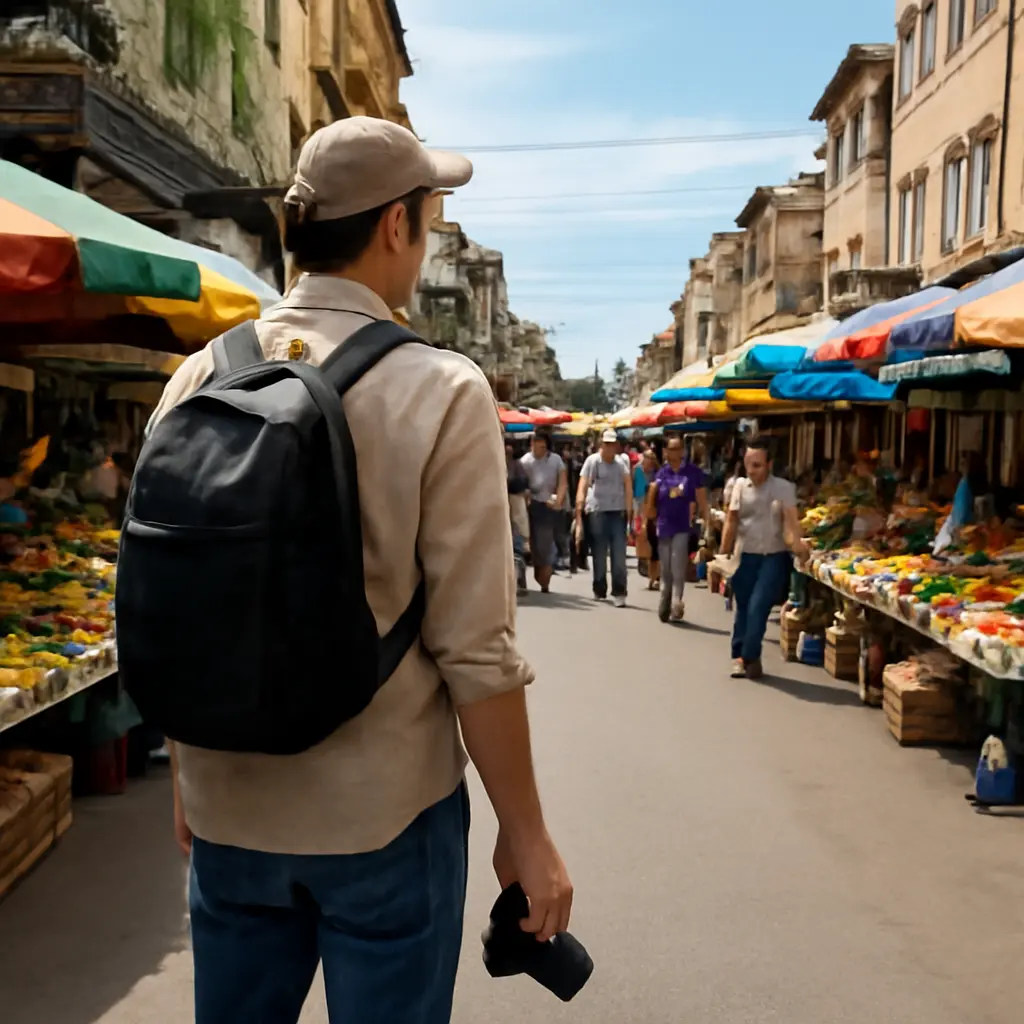
Travel photos are excellent at preserving visible details, but they often leave out the sounds, movement, context, and personal meaning that make a place memorable. That gap matters: a 2021 study by researchers at the University of Southern California and the University of Pennsylvania found that taking photos can improve people’s visual memory for what they see, while sometimes weakening memory for details they did not photograph. The solution is not to stop taking pictures. It is to pair them with deliberate attention, brief notes, audio, and reflection—approaches that help turn a collection of images into a fuller record of a trip.
Travel photos and the limits of visual memory
A travel photo is a visual record made at a particular moment and from a particular viewpoint. It can preserve a landmark, meal, landscape, or expression, but it cannot automatically preserve what happened just before or after the shutter clicked, what the place sounded like, or why the moment mattered to the traveler.
Psychologists refer to one relevant effect as the “photo-taking impairment effect.” In a 2014 study published in Psychological Science, Linda Henkel found that visitors who photographed museum objects remembered fewer objects and fewer details about them than visitors who only observed them. Later research has shown a more nuanced picture: photo-taking can support memory for photographed visual content, while attention and memory for unphotographed information may suffer. The outcome depends on factors such as whether people use a camera or phone, how they frame the task, and whether they engage with the scene while recording it.
Photos preserve a frame, not a whole experience
A photograph freezes a small slice of a continuous event. It can show a busy market stall, for example, but not the bargaining, music, traffic, smells, or conversation unfolding around it. This is a basic property of the medium, not a flaw in the camera: the image records light from one view, while an experience includes multiple senses and changes over time.
The distinction is useful when deciding what to document. A photo works well for color, composition, faces, and visible details. A caption, voice memo, or short journal entry is better for a vendor’s recommendation, the route taken, or the reason a quiet street felt significant.
Attention can shift from the place to the device
Taking a picture requires choices: where to stand, what to include, when to shoot, and whether the image looks good. Those choices can help a traveler notice visual details, but they can also redirect attention toward the screen and the task of making a pleasing image.
Henkel’s museum research provides a practical warning rather than a universal rule against photography. The useful distinction is between photographing while actively noticing and photographing automatically. Pausing to look first, then taking a few intentional images, can preserve both attention and a visual record.
Travel photos and the missing context
Context is the information that helps explain an image: where and when it was made, who is present, what was happening, and why the moment mattered. Without context, even a striking photograph can become hard to interpret later. This is especially true when travelers take many similar images or return to them months or years after a trip.
The scale of personal photo collections makes this challenge familiar. Google Photos announced in 2017 that its users had uploaded more than 500 million photos and videos each day. That company-reported figure illustrates how easily image-making can become abundant; it does not mean that each image receives attention or retains a useful memory on its own.
A photo rarely explains why a moment mattered
The meaning of a travel image is often personal and invisible. A picture of a station might recall a missed train, an unexpected kindness, or the beginning of a difficult journey. Viewers who were not there—and even the photographer years later—may not infer that story from the image alone.
A brief caption can restore the missing link. Instead of writing “old station,” note “We waited here during the storm; the station attendant found us a dry place to sit.” The added sentence records a relationship and an event, not just a location.
Images under-record sound, smell, taste, and movement
Travel is multisensory, while a conventional photograph is primarily visual. It cannot directly reproduce the echo in a cathedral, the rhythm of a street musician, the taste of a regional dish, or the motion of a ferry crossing. These sensory details often help distinguish one place from another in memory.
A short audio recording or written sensory note can complement an image. Travelers should be considerate and follow local rules before recording people, performances, or private spaces. A simple note—“rain on the awning, cardamom in the tea, bells at noon”—can be more evocative than a large batch of nearly identical photographs.
Travel photos and the attention trade-off
The attention trade-off is the balance between documenting an experience and being present for it. Photography can deepen observation when it encourages someone to study light, architecture, or gesture. It can narrow attention when the traveler treats every scene as material for a post or keeps checking the screen instead of looking around.
Research does not support a simple claim that photography always harms memory. The findings instead suggest that effects vary with the task and the information being remembered. A practical approach is to choose moments for documentation and moments for uninterrupted participation.
Photographing can sharpen visual attention
Framing a photograph may prompt a traveler to notice shapes, patterns, contrast, and small visual features. In the 2021 study “Camera Use Increases the Perception of Visual Information,” researchers found that taking photos could increase visual engagement with a scene and improve memory for visual details. The study’s findings help explain why photography can be useful for observation, even though it does not capture every part of an experience.
This benefit is strongest when the camera supports looking rather than replaces it. Try identifying one detail before taking a picture—a carved doorway, a changing reflection, or the arrangement of food—and then put the device away long enough to explore the wider scene.
Constant capture can divide attention
Frequent device use creates repeated interruptions: unlock, frame, shoot, review, edit, and share. Each action can pull attention away from conversation or surroundings. The problem is not the existence of photographs but the habit of making documentation the default response to every moment.
A useful boundary is to decide in advance what deserves a photograph. For instance, take a few images at a viewpoint, then spend the next ten minutes without a screen. At a meal, photograph the table once and return to the conversation. These small limits leave room for both a record and direct experience.
Travel photos and practical ways to fill the gaps
Travel photos become more useful when they are part of a broader memory practice. The aim is not to document everything, but to preserve a balanced sample: a few images, accurate context, sensory details, and personal reflection. The following methods are simple enough to use during a busy trip.
Use a look-first, shoot-second routine
Before taking a picture, pause and observe the scene without looking through the screen. Notice what is changing, what is outside the obvious focal point, and how the place feels. Then take the photograph if it still seems worth making.
This brief pause helps separate attention from capture. It also reduces repetitive shots made without a clear purpose. For a landmark, one establishing image and one detail may be more memorable than dozens of near-duplicates.
Add captions while the details are fresh
A caption is a short written explanation attached to or stored alongside an image. Record the date, location, people, event, and one personal detail. Phone photo apps often allow captions or location information, while a travel journal or notes app works just as well.
Keep captions specific and factual. “Lunch in Lisbon” identifies a broad setting; “A cook recommended the grilled sardines, and we ate outside as the tram passed” restores action and context. Avoid relying entirely on automatic location tags, which may be inaccurate or too general to explain the memory.
Record sound and sensory details selectively
A voice memo can capture a quick reaction, a remembered phrase, or the atmosphere of a location. A written sensory note can record temperature, texture, taste, or movement. These forms are especially helpful for experiences whose most memorable features are not visible.
Use recordings thoughtfully: ask permission when people are identifiable or speaking, avoid disrupting ceremonies and performances, and respect restrictions on photography or recording. A few seconds of ambient sound or a private note may be enough; more recording is not automatically better.
Choose a small set of meaningful images
A curated set is a selection made deliberately rather than a complete camera roll. Choose images that tell different parts of the trip: a place, a person or interaction, a detail, and an unexpected moment. This variety gives the collection a stronger narrative than a long sequence of similar landmark shots.
Selection also makes later viewing easier. During a trip or soon after returning, remove accidental duplicates and label the images that need explanation. Keep original files backed up, but create a smaller album for the photographs that best represent the experience.
Reflect after the visit, not only during it
Reflection means revisiting an experience and connecting its details into a story. After a day of travel, write three short answers: What surprised me? What did I learn? What do I want to remember that is not in a photograph? This takes little time and can reveal which images need captions.
For a group trip, invite each traveler to choose one image and explain why it matters. Different people may remember different conversations, challenges, and discoveries from the same outing. Their accounts make the shared record richer than a single person’s camera roll.
Travel photos and a more complete travel record
Travel photos are strongest when treated as prompts and evidence, not as complete substitutes for memory. They preserve visible moments and can encourage close looking, but they may omit context, sound, sensation, movement, and personal meaning. Research on photo-taking likewise points to a trade-off shaped by how people use cameras and where they direct attention.
To make travel memories more durable, pause before shooting, take fewer purposeful images, add concise captions, record sensory details respectfully, and reflect after the day. These habits help transform photographs from isolated frames into a narrative of what happened and why it mattered. On your next trip, try one screen-free interval each day and add a one-sentence note to the image you most want to remember.
Sources: Linda A. Henkel, “Point-and-Shoot Memories: The Influence of Taking Photos on Memory for a Museum Tour,” Psychological Science, 2014, https://journals.sagepub.com/doi/10.1177/0956797614524585; Alixandra Barasch, Gal Zauberman, and Craig R. M. McKenzie, “How the Intention to Share Can Undermine Enjoyment: Photo-Taking Goals and Evaluation of Experiences,” Journal of Consumer Research, 2018, https://academic.oup.com/jcr/article/44/6/1220/4091230; Alixandra Barasch, Gal Zauberman, and Craig R. M. McKenzie, “Camera Use Increases the Perception of Visual Information,” Psychological Science, 2021, https://journals.sagepub.com/doi/10.1177/0956797620965771; Google, “Google Photos: 500 Million Users and Counting,” 2017, https://blog.google/products/photos/google-photos-500-million-users-and-counting/.

